
Texas Public Education Proposal
Most people in Texas think of public school as providing a good basic education, teaching children reading, writing, and mathematics. Many have fond memories of school and some not so fond memories. Parents want a quality education for their children and the experience of extra-curricular activities and the widening of horizons through learning about new places and ideas. While these expectations are mostly accurate, the credit goes to teachers and parents who remain dedicated to the goals and ideals of creating an educated public.
Little or no credit goes to the establishment political parties as the duopoly sees public education as an opportunity for thier divisive partisan and special interest agendas. Public education policy in Texas is the embodiment of what the political establishment wants from families and children. The ideologies of political actors and desires of special interests have been synthesized into the bureaucratic structure of the Texas Education Agency and cast into a top-down mandate of standards, tests, and judgments. The legislated purpose is to produce high school graduates who will become workers or soldiers, or who will continue in higher education. To the establishment parties, students are the future workforce of the major corporations and the empire. Yet despite the mismanagement by the establishment political parties, the people involved who do the actual work — teachers, administrators, parents, and students — continue their efforts to provide a valuable and beneficial education for students.
Building the future is, in my view, nearly always a better choice than protecting the present, simply because the future will prevail over the present. To prepare for the future, we should not assume the present is the authoritative guide. Our world is in a transformative time, more so than most, and today's establishment may become tomorrow's historical footnote. That is why the educational priority should be students who have basic competence and learn to think and to continue learning instead of the establishment priority of human resources with test scores and certificates.
There are a large number of crises drawing increasing amounts of public attention, such as the ecological, economic, immigration, geopolitical, and energy crises. But there is also an invisible crisis unfolding within our own minds and cultures that is getting much less attention. This is the metacrisis, which has to do with how humans understand themselves and the world. It is a generalised educational crisis involving a set of related psychological dynamics; systems and societies are in trouble, but it is the psyche—the human dimension—that is in the direst of straits.
Education is the Metacrisis: Why it's time to see planetary crises as a species-wide learning opportunity.
Students, Teachers, and Parents Are the Priority
The Texas public school system should be organized around the principal of placing the needs of students as the highest priority. Classroom teachers are the direct link between education policy and the students. Students are most influenced by their home environment and by their teachers. In keeping with these basic facts, it is important that education policy be designed to maximize educational resources and benefits at the level of the classroom teachers and the students, with materials tailored to help parents support their children in school.
In this campaign, I want to highlight the necessity of placing student benefits and teacher resources as the first priority of Texas public school policy. Student benefits include developing competence in foundation skills, healthy nutritious foods, time for physical activity, and time for exploration.
The public school curriculum in Texas is dictated by the Texas Essential Knowledge and Skills (TEKS), which describes the topics to be taught during the school year in each subject. The TEKS are created under the Texas State Board of Education (SBOE). Unfortunately, the SBOE has degenerated into a laughingstock of political hacks who are focused on ideological zealotry and have little regard for student needs. The present SBOE is further evidence of the ruling class assault on public education. SBOE members should be nominated by School Boards and elected by teachers — that way we will at least have some assurance of accuracy, relevance, and coherence in public school curriculum. An accurate, relevant, and coherent curriculum is focused on developing competencies, not on indoctrination. The basic goal of the curriculum, reflected in every subject, should be to develop student proficiency in reading, writing, and mathematics — the three R's — "readin, ritin, and rithmetic." These are the basic skills of all educated people and are the foundation prerequisites of every advanced or specialized subject.
Class curriculum must be appropriate for the age and maturity of the students. Classroom teachers should have a wide choice of easily accessible and modifiable teaching materials and lessons. Lesson supporting materials should also be easily accessible to parents. It would be helpful to have a program in which teacher created lessons are submitted to a group of experienced educators for organizing and revising into an easily edited format, providing several lessons on every topic in the TEKS listing. Teachers should have ready access to these lessons to use or customize. We also should take the positive results of "high impact tutoring" programs as an example of how a varied classroom experience can be an important part of making schools more attractive and beneficial to students.
In addition to improved lesson components for teachers and parents, it would be helpful for Texas to create an education reference database, utilizing materials collected in university libraries, that offers a wide range of appropriate materials for all grade levels and subjects as well as engaging video and multimedia materials. The use of artificial intelligence in this system should be limited such that the AI program would deliver only reference links with minimal text content. This could be a significant help in creating a varied and interesting school experience for students.
In a notable change from the usual pattern of accommodating corporate interests, Texas instituted a ban on cell phones in school. I definitely believe that, due to addictive programming, cell phones are harmful to students and are a major distraction in school. However, simply banning cell phones without also seriously making the school day more interesting and engaging for students will likely lead to unanticipated problems, especially increased absenteeism and disciplinary issues.
Administration of public schools should be reoriented to the policy of placing student benefits and teacher resources as the first priority. As a former classroom teacher, I can attest to the fact that school administrators are too often hostile or unsupportive towards teachers. Working conditions are sometimes oppressive and often resources are scarce. Instead of building a bureaucracy, public school administration should be about providing a safe and rewarding educational environment, relying on teachers as the contact point between the beneficial goals of education and the students, and relying on parents to provide support and encouragement to their children. The Texas Education Agency shoud be tasked with answering this simple question: Do the students and teachers want to go to school?
Redirect the Bureaucracy
Complaints about school administrators aside, it is extremely difficult to prioritize students under the present evaluation system. Avoiding failure under the accountability regimen becomes the priority of school administrators. The Texas Education Agency evaluates the academic performance of Texas public school districts and open-enrollment charter schools. The criteria, described in the TEA Accountability Data resources, include standardized test results, comparison of current test results with past results, graduation and dropout rates, career readiness certificates, and college preparatory and dual credit classes. Test scores and bureaucratic compliance are the measures of success, while student human development, practical competence, and thinking ability are merely assumed results which have no bearing on accountability.
We also must recognize that Texas public education functions in an environment of stifling bureaucratic control. Bureaucratic Management Theory, developed by Max Weber, holds that bureaucracy serves as the most stable and efficient framework for managing complex systems. The bureaucratic system creates a hierarchy with decision-making power at the top and accountability distributed downwards. Teachers are the lowest level of the state education bureaucracy with little power and high accountability. Yet the education bureaucracy has no reliable way to measure student development, relying instead on indicators such as test scores. The problems of bureaucratic management are widely recognized to include alienation of the individual, ignoring human needs, creation of a sterile environment, and supplanting goals with procedural strictness. Most complaints against public education can be related to these problems with bureaucracy.
Limit Special Interests
Any discussion of education policy must deal with the constant pressure from special interest groups to incorporate their agendas into the public education system. This is perhaps most controversial in the cases of inclusive and religious curriculum, each representing opposing sides of the political spectrum. These issues reflect the "divide and rule" approach of the establishment political parties and the political parties promoting these divisive issues are harming public education.
According to the National Center for Education Statistics (NCES), there has been a steady rise in the number of homeschooled children in the US . . . . Why is there such growth? According to Mayberry (1991), more and more families, perceiving the public schools as battlegrounds for the political and social interests of a wide variety of social sectors, are becoming disillusioned "with the quality and content of state-sponsored education"
Socialization in Schools
All participants in the education policy debate claim to place benefits to students as the highest priority, but it is clear the partisans want something from education as opposed to offering something for education.
Special interest pressure on public education is actually more pervasive in the case of the corporate agenda, but this corporate influence is not a cause for partisan division. Both establishment parties are happy to use public schools to promote corporate products and corporate ideologies. The American public school system was developed with very strong influence from corporate interests, to the extent that the basic design of the school day is a form of preparation for factory employment. Accordingly, one of the main purposes of public education is to prepare students for careers or employment with discipline, job skills, and corporate values.
Thus, the goals of public education to benefit students and society are overridden by special interest agendas, bureaucratic imperatives, and corporate ideologies.
What Should Be
The remedy for these problems is greater support for and reliance on teachers and parents, providing much better resources to teachers, more regard for parents, and a philosophy that recognizes students as young human beings who are entitled to respect, dignity, and continuous attention to their needs. School administration should be transformed from managing teachers to supporting teachers as they encourage student development, growth, and competence. The human element of education deserves far greater influence in the process.
The lasting value of public education is its uplifting of ordinary people and support of an enlightened citizenry. As George Washington said in his Farewell Address:
Promote then, as an object of primary importance, institutions for the general diffusion of knowledge. In proportion as the structure of a government gives force to public opinion, it is essential that public opinion should be enlightened.
Measuring Public Schools
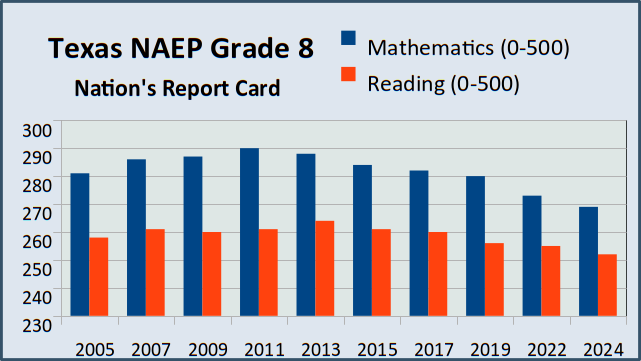
Evaluating public education has been done through the National Assessment of Educational Progress NAEP, or The Nation's Report Card. This is a Congressionally mandated evaluation which provides results for grades 4, 8, and 12. The chart of NAEP scores for 8th grade Mathematics and Reading shows that Texas results have been declining since the year 2011. This is evidence that high-stakes testing has little or no positive effect on student achievement. Parents recognize this discrepancy as the STAAR Test has not earned parental confidence. In fact, the evidence suggests that the Texas "standards, testing, and accountability" design for public education has been a long-running failure and there is no reason to expect improvement in the future.
An alternative method of evaluating student development and progress is presented as "Lectical Levels" discussed in this video. The Lectical Scale is a scale of increasing complexity, so a score on the scale represents the complexity level of a particular task or activity. It is possible for people to keep developing on the Lectical Scale for as long as they're learning new things and connecting what they learn to their existing knowledge. There is also development of community-based accountability systems as an alternative way of determining, measuring, and reporting school accountability. In this view, an accountability system should be bottom-up, where local communities determine the goals and acceptable outcomes for their students and schools. These and other alternatives to high-stakes testing deserve consideration in the educational policy debate.
Education is a task that must be done every day by students, parents, and teachers. There is no cookie-cutter or once-and-done solution for this essential project.
Texas standardized testing began in 1980 with the TABS test, replaced by the TEAMS test, then the TAAS, the TAKS, the TEKS, and the STAAR test. The emphasis on standardized, high-stakes testing began in the 1980's with the Reagan administration claiming that public education was failing and was harming America. The political strategy of reducing funding while raising expectations was successful in increasing criticism of public schools and justifying high-stakes testing. Standardized, high-stakes testing was used as a way of disparaging public schools and local neighborhoods, manipulating curriculum and teachers, and elevating test results to the primary concern of school administrators. In short — everything in school is made to revolve around passing the test, to the detriment of curiosity, exploration, and love of learning. The decades long campaign against public schools relies on high-stakes testing as a method of attacking public education.
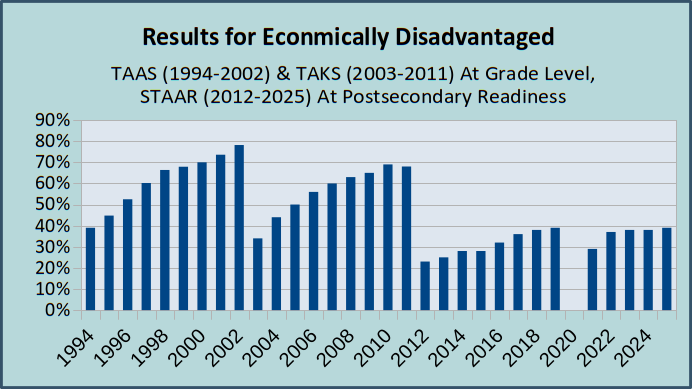
Testing was put forward as a way of enforcing standards and creating accountability. But rather than an objective measure, standardized test results can generally be predicted by socioeconomic levels, with schools in poor districts having significantly lower scores. The TAAS and TAKS test results for economically disadvantaged students show yearly increases, perhaps as a result of "teaching to the test," but the STAAR Test results show consistent lower scores (data from Texas Education Agency). The STAAR Test format was revised is 2025. Under the new design, the STAAR Test, now called the Student Success Tool (SST), will, with some exceptions, be given in three increments — beginning of year, middle of year, and end of year. I am not confident the social class bias will change with the 2025 revisions. Replacing the STAAR Test with the SST Test will likely only strengthen the emphasis on high-stakes testing.
If we must continue with the STAAR or SST Test, it should be given in units and integrated into the lesson progression, with very quick return of results, and an option for teacher grading. The SST Test should be a positive part of the learning experience instead of the judgmental ordeal the STAAR Test has been.
I also want to make the point that state required testing should be constrained by the legitimate state interest in testing. In my opinion, this does not include concepts such as "academic excellence". This is certainly a legitimate educational goal, but the purpose of a state required test is simply to obtain a valid indicator of student knowledge, which should not be confused or mixed with other purposes. State testing that is not specifically tailored to legitimate state interest is disrespectful to students. The evidence is clear that state high-stakes testing does not contribute to student development and trying to justify it with other desirable goals serves no constructive purpose.
Educational Savings Accounts (Vouchers)
In 1955, the economist Milton Freedman wrote The Role of Government in Education arguing that "Governments could require a minimum level of education which they could finance by giving parents vouchers redeemable for a specified maximum sum per child per year if spent on 'approved' educational services." The voucher concept places emphasis on choice and competition as a means of increasing educational performance and parental and student satisfaction. This is included in the Republican Party Project 2025 Mandate For Leadership, Chapter 11, as a key component of the corporate ideology that guides this political playbook. The concept of vouchers places the parent as a "consumer" of education and gives the provider school an incentive to appeal to the parent. But the more important issue is the incentive to provide high quality education, which is not directly addressed by the voucher concept. In the corporate mindset the question is: "How can primary and secondary education be a profitable business?" The answer is by increasing revenues — higher voucher amounts, and by reducing expenses — lower staff compensation and lower operating expenses, and reducing the cost of ancillary or extra-curricular activities. In short, the voucher concept only works if state spending increases and school quality declines. There are ways for schools to increase revenue by fundraising, but this is not a reliable way of assuring quality education for all students.
The Texas school voucher program, created in 2025, will further impair public education. Most voucher recipients were already paying private school tuition and sending their children to private schools. By creating a large new expense for the state budget, the voucher program creates budget pressure on many other state programs and further diverts public monies to benefit the wealthy. The experience with Educational Savings Accounts shows that benefits flow to the wealthiest levels of the economic hierarchy. We see that the voucher program is a typical transfer of public resources to the upper class.
Rather than a benefit, school voucher programs have been demonstrated to be a detriment. According to "School Choice" and Educational Savings Accounts (ESAs)" the voucher program will negatively impact rural communities, have hefty financial and long-term costs, will not benefit students living in poverty, and will compromise education for children with disabilities. Experience in other states shows that voucher programs have very little, if any, positive effects on academic outcomes.
Public School Spending
According to Census Bureau data, in 2004 Texas spent about $12,895 per student on public schools, which ranks Texas at 43rd in the nation. When federal funding is included, the per-pupil amount is raised to about $15,400.
In 2025 the Texas Legislature increased public school funding. This increase is approximately enough to compensate for inflation. The 2025 Legislature passed a number of bills regarding public education that averted an embarrassing funding crisis, but, with the exception of the voucher program, did not make any significant changes in education policy. Despite the headline, the changes are described in the 2025 Legislative Recap: "An agenda driven by conservative priorities, schools' financial duress and teacher needs led to an $8.5 billion boost, new discipline rules, more Christianity in classrooms and a DEI ban." See this article for additional background.
I believe spending allocations could be adjusted to place more resources within reach of teachers, students, and parents, but it would take considerable public pressure to bring that reallocation about. I do not believe the establishment parties are capable of seeing beyond the special interests, campaign contributors, and partisan issues that drive their political agendas. Positive change in Texas education policy requires a demand by the public that the Legislature truthfully places priority on supporting students, parents, and teachers.
The more votes for Kevin McCormick for Lieutenant Governor in the November election, the more likely it becomes that the Legislature will respect the public interest in a public education system designed and managed for the best interests of students, parents, and teachers.
Regards
Public Education Budget Detail
The table below gives the public school budget for 2026, according to the school finance reports and data by the Texas Education Agency (my copy). The expenditures are shown by three categorizations called "objects, functions, and programs," but you will see the total expenditures of $84,047,516,900 are the same under each categorization. Percentages in bold are percent of the Grand Totals. Data on enrollment is not in the table below, but the enrollment data shows the total public school enrollment to be 5,453,271 students. Dividing total expenditures by total enrollment results in a per-pupil expenditure of $15,412. However, expenses also include non-operating expenses of $14,753,673,330, resulting in non-operating expense of $2,705 per pupil, bringing the net expenditures per pupil to $12,706.
| Texas 2026 Public School Budget | |||
|---|---|---|---|
| Line Description | TAB 25_26 AF Bud COL ROW | Total by Column | Percent of Total |
| Revenues Operating Revenue | |||
| Local Property Tax from M&O (excluding recapture) | G1 | $26,926,043,816 | 31.96 |
| State Operating Funds | H1 | $32,949,187,723 | 39.11 |
| Federal Funds | I1 | $3,865,377,345 | 4.59 |
| Other Local | J1 | $2,711,826,008 | 3.22 |
| Total Operating Revenue | K1 | $66,452,434,892 | 78.87 |
| Other Revenue | |||
| Local Property Tax from I&S | L1 | $11,675,966,763 | 13.86 |
| State Assistance for Debt Service | M1 | $1,026,800,754 | 1.22 |
| Misc Rev Debt Service Fund (F599) | N1 | $214,857,625 | 0.26 |
| Other Receipts (excluding debt service financing) | O1 | $536,097,482 | 0.64 |
| Total Other Revenue | P1 | $13,453,722,624 | 15.97 |
| Subtotal: Operating and Other Revenue | Q1 | $79,906,157,516 | 94.84 |
| Recapture Revenue | |||
| Local Property Tax Recaptured | R1 | $2,540,502,699 | 3.02 |
| Total Recaptured Revenue | S1 | $2,540,502,699 | 3.02 |
| Subtotal: Operating, Other and Recaptured Revenue | T1 | $82,446,660,215 | 97.86 |
| Debt Service Financing and TRS Estimate Revenue | |||
| Debt Service Financing Related Revenue | U1 | $1,244,675,055 | 1.48 |
| Estimated State TRS Contributions | V1 | $3,102,275,617 | 3.68 |
| Subtotal: Debt Service Financing and TRS Estimate Revenue | W1 | $4,346,950,672 | 5.16 |
| Grand Total: Operating, Other, Debt Service Financing, and TRS Estimate Revenue excluding recapture | X1 | $84,253,108,188 | 100 |
| Expenditures Operating Expenditures by Object (61xx-64xx only) | |||
| Payroll Expenditures (Object 61xx) | Y1 | $55,248,789,864 | 65.74 |
| Professional & Contracted Services (Object 62xx) | Z1 | $6,913,985,213 | 8.23 |
| Supplies & Materials (Object 63xx) | AA1 | $4,808,201,616 | 5.72 |
| Other Operating Expenditures (Object 64xx) | AB1 | $2,322,866,877 | 2.76 |
| Total Operating Expenditures by Object | AC1 | $69,293,843,570 | 82.45 |
| Non-Operating Expenditures by Object | |||
| Capital Outlay (Object 61xx-64xx) | AD1 | $17,314,367 | 0.02 |
| Debt Services (Object 65xx) | AE1 | $13,829,637,762 | 16.45 |
| Capital Outlay (Object 66xx) | AF1 | $906,721,201 | 1.08 |
| Total Non-Operating Expenditures by Object | AG1 | $14,753,673,330 | 17.55 |
| Grand Total: Operating and Non-Operating Expenditures by Object | AH1 | $84,047,516,900 | 100 |
| Operating Expenditures by Function (61xx-64xx only) | |||
| Instruction (Function 11,95) | AI1 | $38,018,763,003 | 45.23 |
| Instructional Resources & Media Services (Function 12) | AJ1 | $611,225,020 | 0.73 |
| Curriculum & Staff Development (Function 13) | AK1 | $1,079,578,353 | 1.28 |
| Instructional Leadership (Function 21) | AL1 | $1,116,633,120 | 1.33 |
| School Leadership (Function 23) | AM1 | $4,121,061,246 | 4.9 |
| Guidance Counseling Services (Function 31) | AN1 | $2,557,260,337 | 3.04 |
| Social Work Services (Function 32) | AO1 | $160,962,142 | 0.19 |
| Health Services (Function 33) | AP1 | $750,095,703 | 0.89 |
| Transportation (Function 34) | AQ1 | $2,259,256,235 | 2.69 |
| Food Services (Function 35) | AR1 | $4,001,181,241 | 4.76 |
| Extracurricular (Function 36) | AS1 | $1,917,935,837 | 2.28 |
| General Administration (Function 41,92) | AT1 | $2,450,018,436 | 2.92 |
| Facilities Maintenance & Operations (Function 51) | AU1 | $7,435,026,367 | 8.85 |
| Security & Monitoring Services (Function 52) | AV1 | $1,184,739,035 | 1.41 |
| Data Processing Services (Function 53) | AW1 | $1,414,433,567 | 1.68 |
| Community Services (Function 61) | AX1 | $196,322,575 | 0.23 |
| Fund Raising CHARTER SCHOOLS ONLY (Function 81) | AY1 | $19,351,353 | 0.02 |
| Total Operating Expenditures by Function | AZ1 | $69,293,843,570 | 82.45 |
| Non-Operating Expenditures by Function | |||
| Capital Outlay (Object 61xx-64xx) | BA1 | $17,314,367 | 0.02 |
| Non-Operating Expenditures by Function (1x-9x) (65xx) | BB1 | $13,829,637,762 | 16.45 |
| Non-Operating Expenditures by Function (1x-9x) (66xx) | BC1 | $906,721,201 | 1.08 |
| Total Non-Operating Expenditures by Function | BD1 | $14,753,673,330 | 17.55 |
| Grand Total: Operating and Non-Operating Expenditures by Function | BE1 | $84,047,516,900 | 100 |
| Operating Expenditures by Program Intent Code (PIC) (61xx-64xx only) | |||
| Basic Educational Services (PIC 11) | BF1 | $29,635,208,404 | 35.26 |
| Gifted and Talented (PIC 21) | BG1 | $387,960,574 | 0.46 |
| Career and Technical (PIC 22) | BH1 | $2,610,765,770 | 3.11 |
| Students with Disabilities (PICs 23,33) | BI1 | $9,394,358,205 | 11.18 |
| State Compensatory Education (PICs 24,26,28,29,30,34) | BJ1 | $3,512,059,173 | 4.18 |
| Bilingual (PICs 25,35) | BK1 | $1,049,398,536 | 1.25 |
| Early Education Allotment (PIC 36) | BL1 | $1,509,246,206 | 1.8 |
| Dyslexia or Related Disorder Services (PIC 37) | BM1 | $344,346,508 | 0.41 |
| College, Career, and Military Readiness (CCMR) (PIC 38) | BN1 | $419,747,002 | 0.5 |
| Athletics/Related Activities (PIC 91) | BO1 | $1,390,095,002 | 1.65 |
| Un-Allocated (PIC 99) | BP1 | $19,040,658,190 | 22.65 |
| Total Operating Expenditures by Program Intent Code (PIC) | BQ1 | $69,293,843,570 | 82.45 |
| Non-Operating Expenditures by PIC | |||
| Capital Outlay (Object 61xx-64xx) | BR1 | $17,314,367 | 0.02 |
| Non-Operating Expenditures by PIC (1x-9x) (65xx) | BS1 | $13,829,637,762 | 16.45 |
| Non-Operating Expenditures by PIC (1x-9x) (66xx) | BT1 | $906,721,201 | 1.08 |
| Total Non-Operating Expenditures by Program Intent Code (PIC) | BU1 | $14,753,673,330 | 17.55 |
| Grand Total: Operating and Non-Operating Expenditures by Program Intent Code (PIC) | BV1 | $84,047,516,900 | 100 |
| Disbursements Total Disbursements | |||
| Operating Expenditures | BW1 | $69,293,843,570 | 79 |
| Recapture | BX1 | $2,540,502,699 | 2.9 |
| Total Other Uses | BY1 | $327,676,274 | 0.37 |
| Intergovernmental Charge | BZ1 | $797,796,080 | 0.91 |
| Capital Outlay (Object 61xx-64xx) | CA1 | $17,314,367 | 0.02 |
| Debt Service (Object 6500) | CB1 | $13,829,637,762 | 15.77 |
| Capital Projects (Object 6600) | CC1 | $906,721,201 | 1.03 |
| Total Disbursements | CD1 | $87,713,491,953 | 100 |